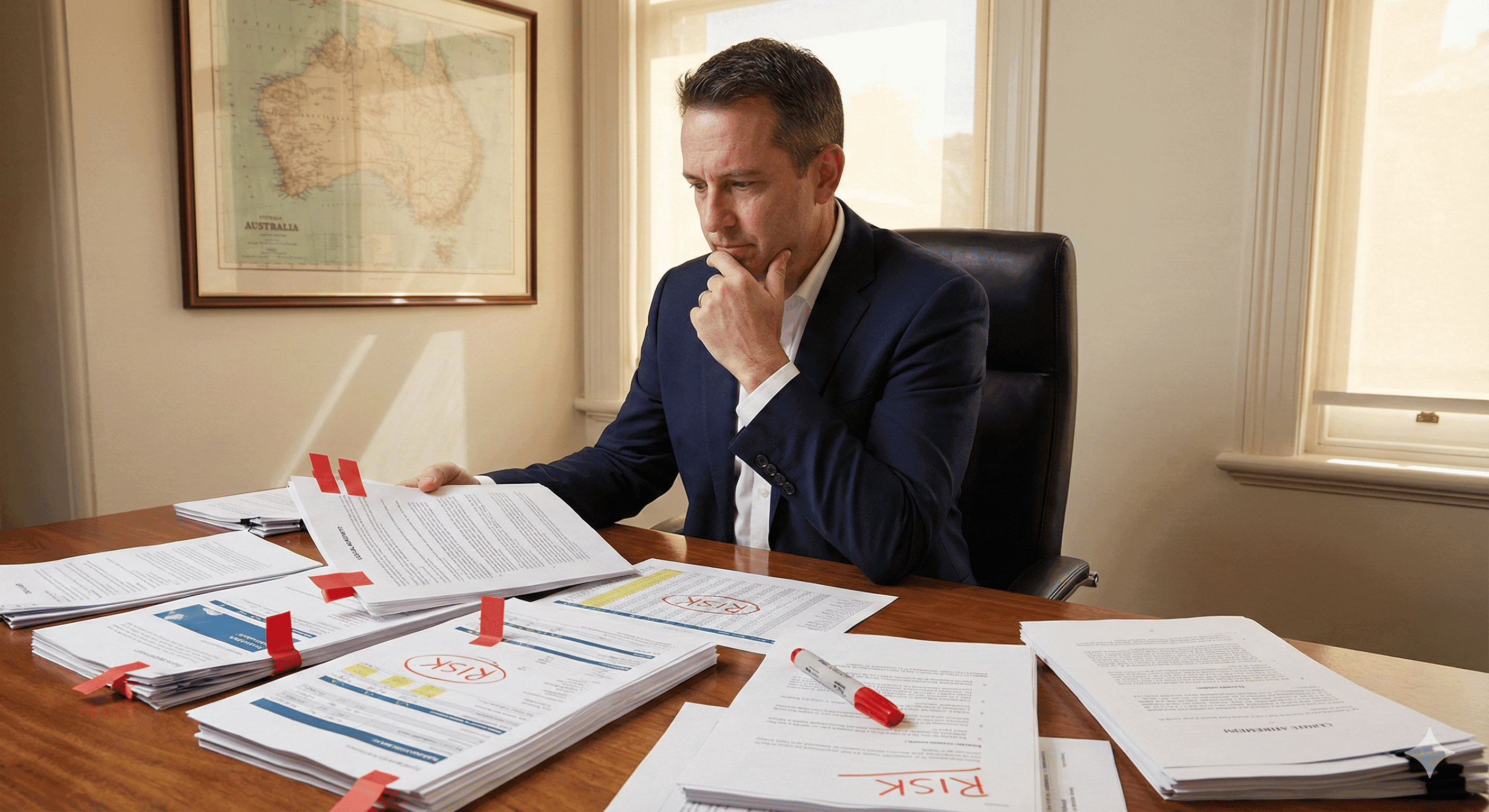
Common Mistakes When Buying A Business In Australia (And How To Avoid Them)
Introduction: Most Business Purchases Fail For Preventable Reasons
Buying a business is one of the most powerful ways to accelerate wealth creation, income generation and entrepreneurial growth. Yet despite strong intentions and significant capital investment, a large percentage of business acquisitions underperform or fail altogether.
The cause is rarely bad luck. It is almost always structural error, poor decision-making, emotional buying, or insufficient professional guidance.
In the Australian market, many buyers enter acquisitions with confidence but without a framework. They focus on opportunity instead of risk, excitement instead of strategy, and speed instead of precision.
This guide outlines the most common mistakes buyers make when purchasing a business in Australia, and how intelligent, strategic buyers actively avoid them.
Mistake 1: Buying Based On Emotion Instead Of Strategy
Many buyers fall in love with a business idea, brand image, or surface-level success story. They imagine themselves owning the lifestyle rather than objectively analysing the mechanics of the operation.
This leads to:
- Ignoring financial red flags
- Overestimating personal impact
- Justifying weak data
- Rushing due diligence
Successful buyers separate emotion from evaluation. They buy based on performance, structure and sustainability, not attraction or aspiration.
Mistake 2: Overpaying For The Business
Overpaying is one of the most damaging mistakes a buyer can make. Even a strong business becomes a poor investment if acquired at an inflated price.
Common causes of overpaying include:
- Competitive bidding pressure
- Poor valuation understanding
- Seller manipulation
- Unrealistic growth assumptions
- Fear of missing out
Strategic buyers anchor pricing to verified data, conservative forecasts and disciplined valuation models.
Mistake 3: Skipping Proper Due Diligence
Rushing or minimising due diligence exposes buyers to hidden liabilities, overstated profits and operational weaknesses.
This often results in:
- Discovering issues post-settlement
- Inheriting legal disputes
- Uncovering inaccurate financials
- Facing compliance failures
Due diligence is not a formality. It is the buyer’s primary defence against expensive mistakes
Mistake 4: Underestimating Owner Dependence
Many businesses appear profitable but are heavily reliant on the current owner’s personal involvement, relationships or expertise.
When the owner exits, performance drops.
Signs of high owner dependence:
- Owner manages all key relationships
- Lack of documented systems
- No management layer
- Owner handles sales, operations and finance
A business must function independently to be sustainable.
Mistake 5: Ignoring Cash Flow Reality
Revenue does not equal profit. Profit does not equal cash flow.
Buyers often focus on top-line figures while ignoring:
- Working capital requirements
- Seasonal variability
- Payment cycles
- Inventory funding needs
- Cash flow timing gaps
Poor cash flow planning can cripple even profitable enterprises.
Mistake 6: Failing To Assess Industry Viability
A well-run business in a declining industry is still a high-risk investment.
Buyers must evaluate:
- Industry growth trends
- Market demand stability
- Regulatory changes
- Technological disruption
- Shifting consumer behaviour
Future potential matters more than historical success.
Mistake 7: Weak Negotiation Strategy
Many buyers lack structure in negotiation, resulting in:
- Over-generous terms
- Unfavourable payment conditions
- Insufficient risk protection
- No performance safeguards
Negotiation should be strategic, data-backed and professionally guided.
Mistake 8: No Transition Or Handover Plan
Acquisition success depends heavily on how the transition is managed.
Without a structured handover, buyers risk:
- Staff disengagement
- Customer loss
- Operational disruption
- Knowledge gaps
A disciplined transition protects continuity and performance stability.
Mistake 9: Attempting The Process Alone
Many buyers believe professional support is an avoidable cost. In reality, it is risk insurance.
Without expert assistance, buyers miss:
- Market benchmarks
- Negotiation leverage
- Risk identification
- Structural deal optimisation
The cost of errors far exceeds the cost of expertise.
How Strategic Buyers Approach Acquisitions Differently
Professional buyers follow a structured process:
- Clear acquisition criteria
- Market research and screening
- Professional valuation modelling
- Comprehensive due diligence
- Strategic negotiation
- Structured settlement and transition
This turns acquisition from guesswork into strategy.
The Role Of A Business Buyers Agent In Mistake Prevention
A specialist business buyers agent prevents costly errors by:
- Identifying risks early
- Providing objective guidance
- Structuring smart deal terms
- Coordinating professionals
- Eliminating emotional decision-making
They act as your shield, strategist and leverage partner throughout the process.
Why The Most Expensive Mistakes Are Silent
The most damaging acquisition mistakes often go unnoticed until months or years later:
- Slow revenue decline
- Cultural misalignment
- Inefficient systems
- Poor integration
- Hidden liabilities
By the time they surface, reversing damage is expensive and difficult.
Smart Acquisition Is About Avoiding Regret, Not Chasing Deals
Successful buyers are not defined by the number of businesses they purchase, but by the quality of decisions they make.
Each acquisition should be assessed as a strategic investment, not a rushed opportunity.
Disciplined buyers avoid regret. Impulsive buyers inherit it.
Final Thought: A Good Deal Is Never Urgent
The right business will stand up to scrutiny, due diligence and negotiation. Pressure and urgency are often tools to bypass logic.
True confidence comes from understanding, preparation and independent assessment.
If you want to buy with clarity, precision and confidence, Axium Business Buyers ensures every acquisition decision is strategically sound, professionally guided and commercially intelligent from the very first step.